hit piece.
The motive. The lies. The omissions.

The tricks

Ten moves. You’ll see them everywhere once you know them.

Every takedown on this site tags the tricks it found. These are the tricks. Most of them don’t need a lie you could catch with a fact-check; that’s what makes them work.

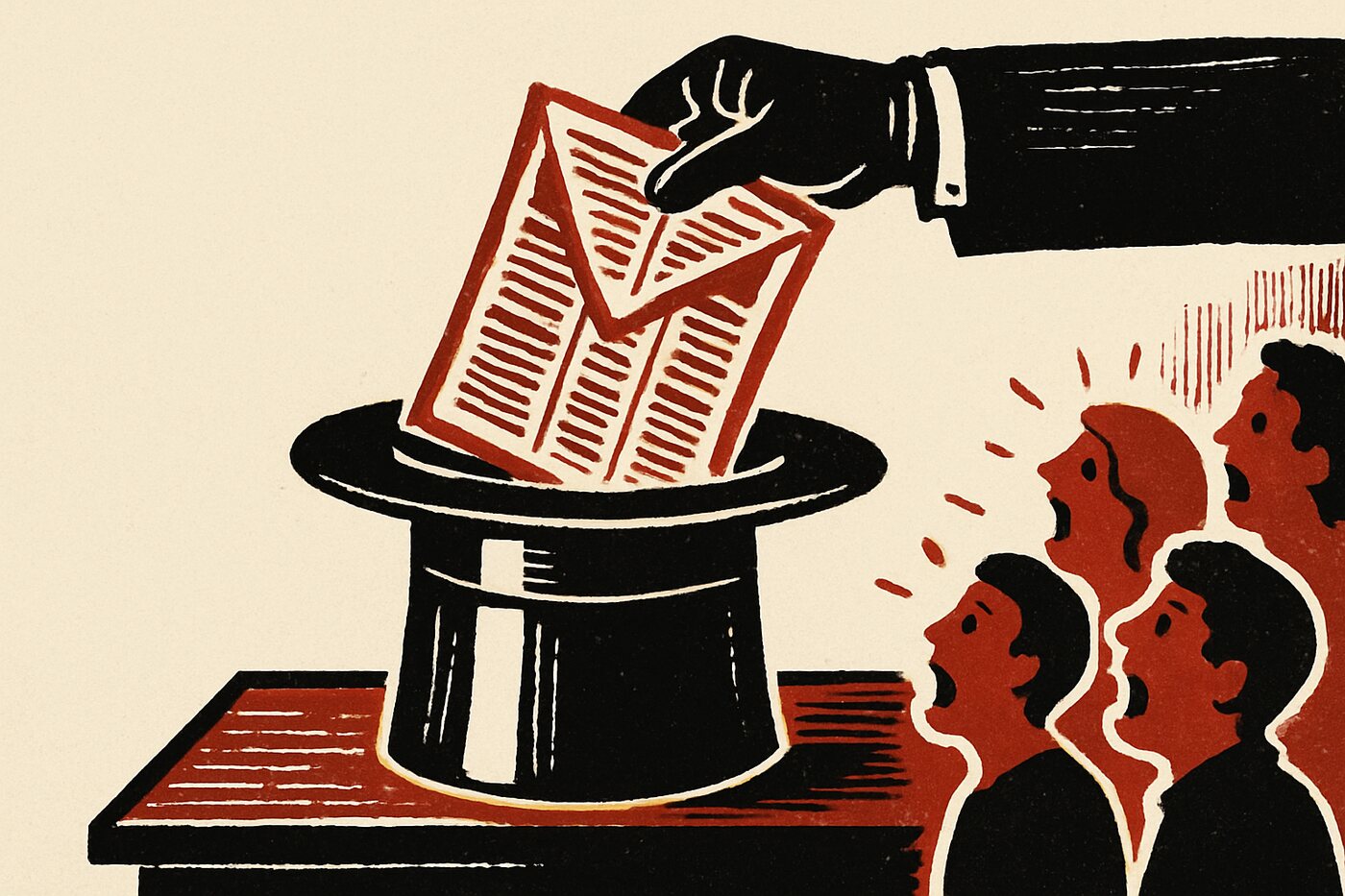
A gloved hand pulls a folded newspaper out of an upturned top hat while a small crowd watches open-mouthed.

Quote chop

A quote cut, or paraphrased inside quotation marks, so it says something the full passage doesn’t.

The cheapest trick in the book. Take a real sentence, cut it where the meaning turns, and print the half that sounds worst. The advanced version is a critic’s summary wrapped in quotation marks so it looks like the target’s own words. The tell: the quote has no link, or the link goes somewhere that doesn’t contain it.

How to spot it: Find the original. Read one sentence before and one after.

Guilt by association

A knows B. B believes something awful. So A must too.

The story establishes a real connection (a shared interest, an essay, a donation) and then hands you an unrelated belief as if it came with it. Nobody ever says A holds the belief, because nobody can. You are meant to fill that in yourself.

How to spot it: Ask: where is the sentence where A actually says it? If there isn’t one, the story owes you one.

Mind-reading

Someone’s secret motive stated as fact.

"They say X, but what they really want is Y." A claim about what is inside another person’s head, with no memo, no recording, no admission, just a critic who finds the darker explanation more useful. It is unfalsifiable by design, which is the point.

How to spot it: Look for the evidence of the motive, not of the behavior. Usually there is none.

Name-calling

An insult doing the job an argument should.

"Nutty professor." "Doomsday cult." "Messiah complex." Labels tell you how to feel about someone before you have heard what they said. They cost nothing to write and nothing to prove, and they work: once the label lands, the argument gets read as the ravings of a nut.

How to spot it: Strike the adjectives and read what’s left. If nothing is left, that was the whole argument.

Timeline shuffle

Events reordered so one looks like it caused another.

"First they cared about animals, then COVID came, then they moved on to AI." A tidy sequence that leaves out the years when all three overlapped. Chronology is persuasive, so a false one is worth faking.

How to spot it: Get the dates. Put them in order yourself.

The missing “if”

The condition that made a statement true, quietly dropped.

Philosophers, scientists and lawyers speak in conditions: if this, then that. Remove the "if" and a careful hypothetical becomes a monstrous decree. It is the technique of choice for turning a thought experiment into a confession.

How to spot it: When a quoted position sounds insane, look for the "if" that was cut off the front of it.

One-source chorus

Several "experts" who all work for the same shop.

Two or three named critics create the feeling of a consensus. Then you check, and they draw their salaries from the same advocacy group with the same agenda. That is one source wearing different hats, and the story should have told you.

How to spot it: Look up where each quoted expert works. Count the employers, not the names.

Never / always

An absolute claim that a single example kills.

"They never give a timeline." "He always sides with the corporations." Absolutes are easy to say and impossible to defend; one counterexample and the sentence is false. Writers use them because they sound like knowledge.

How to spot it: Find one counterexample. That’s all it takes.

The reversal

The story says the opposite of what the source actually argues.

Not a distortion, a flip. The argument says future lives matter enormously; the story says they become insignificant. Sometimes it is sloppiness. Sometimes the reversed version is simply the one that fits the story. Either way the reader is now arguing with a position nobody holds.

How to spot it: Read the source’s own summary of its position. Compare it word for word.

Convenient timing

A story that lands the day after someone powerful needed it to.

A political memo names a target on Wednesday. A hit piece on the same target runs Thursday morning, making the same argument, quoting the same side. Timing alone doesn’t prove anyone made a phone call. It does tell you whose interests the story serves, which is the question that matters.

How to spot it: Check what happened in the news the day before publication. Ask who benefits.