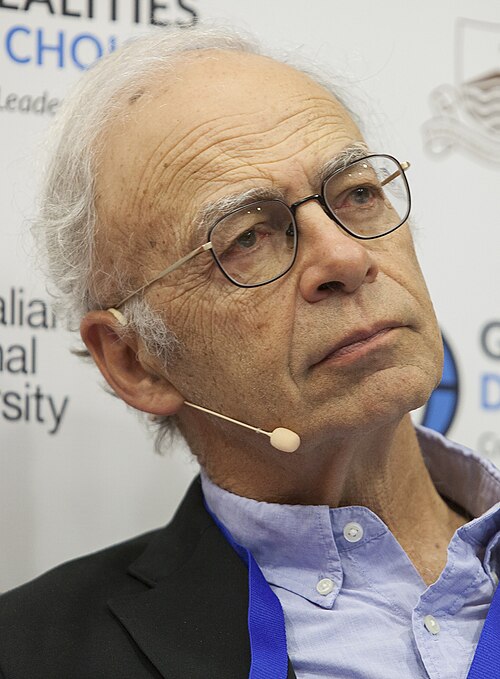
Peter Singer is a philosopher who argues that killing a newborn can be justified in some circumstances, with decisions made by parents and doctors. His examples go beyond ending unbearable suffering.
The NY Post uses his views to attack Sam Altman and Dario Amodei, who lead major AI companies. Its link between them is effective altruism, a movement concerned with doing the most good.
But the article gives no evidence that either executive shares Singer’s views on infants or animals. It also cuts important conditions from Singer’s argument.
You can reject that argument and still expect the newspaper to report it accurately.
Propaganda: Built to make you believe a falsehood that serves someone.
Fabricated: Made up.
Why
The NY Post ties AI executives to Singer’s views without evidence that they share them. It cuts conditions from his arguments, reverses one argument’s meaning and relies on two critics from the same advocacy group.
That AI executives share Peter Singer’s most shocking views on infants and animals.
That this makes their warnings about AI a cult’s attempt to grab power.
What’s actually true
Singer argues that killing a newborn is not the same as killing a self-aware person with a sense of their own future. He says killing a newborn can be justified in some circumstances, with decisions made by parents and doctors. His examples go beyond ending unbearable suffering.
The NY Post cut the reasoning and every one of those conditions, and printed what was left as his view.
Effective altruism is about where charity does the most good. No endorsement of Singer’s views on infants or animals by either AI executive is cited, and we found none.
Both critics work for the same advocacy group, and they are the story’s only critical sources.
The story ran the morning after a Trump adviser’s memo targeted Amodei through effective altruism.
A researcher at Capital Research Center. He supplies the claim about future lives and says AI-risk advocates never give timelines. We check both below.
A conservative advocacy group promoting free markets and limited government. The two critics share an employer and an outlook.
The timing
September 24 → 25
Axios reported a Trump adviser’s memo linking effective altruism to Dario Amodei on September 24. This story ran at 6:30 the next morning, making the same connection and quoting the same side.
More about this role
The timing and shared argument are documented. They do not establish that anyone coordinated this article.
They said AI bosses “picked up” Singer’s theories.
Actually: One of them wrote an essay about charitable giving in 2010. No endorsement of Singer’s views on infants or animals is cited, and we found none.
01The nutty professor dubbed the “father” of effective altruism (EA), the theory beloved by AI doomers who want the power to police the technology, expressed support for bestiality and said the life of a newborn baby is worth less than a chimp’s or a hog’s.
Our rewrite · Missing context added
Philosopher Peter Singer helped inspire effective altruism, a movement that asks how to do the most good with the resources we have. He has also defended infant euthanasia in some cases and challenged sexual taboos. Those positions are his; a connection to effective altruism does not show that other people share them.
Why this wording · sources
“Nutty professor” is an insult, not an argument.
The name-calling starts before the explanation. Later, “doomsday cult” and “messiah complex” do the same kind of work: they give you a reason to dismiss the people before weighing their case.
None of those labels tells you whether Singer’s argument is sound, whether an AI forecast is credible, or what a proposed safety rule would do.
02Peter Singer is an Australian philosopher and bioethicist who argues that killing disabled infants is not morally wrong, that sex with animals is preferable to raising them for food and that even necrophilia can be moral.
Our rewrite · Conditions included
Singer defends infant euthanasia in some circumstances, including cases beyond ending unbearable pain. Published interview excerpts also describe him accepting sexual contact with an animal assumed to participate willingly, and sex with a corpse if the person had agreed before death.
Why this wording · sources
Singer’s case for euthanasia comes with conditions the opening leaves out.
Singer does not give blanket approval to killing disabled babies. His examples concern particular decisions and circumstances. Some involve suffering; the hemophilia example later in the article goes further, involving a baby who could have a happy life.
The sexual examples also make assumptions: an animal treated as willing, or permission given before a person’s death. Those assumptions are part of what he is defending. They are not proof that real cases meet them.
03Since the 1970s, he has suggested rejecting traditional concepts of right and wrong and replacing morality solely by calculating and maximizing interests.
Photo caption: Peter Singer has been dubbed the “father” of effective altruism, the theory beloved by AI doomers. — AFP via Getty Images
We have no quarrel with this paragraph. The “Our rewrite” view only spells out who is saying what.
Our rewrite · Meaning made clear
Singer judges actions by how they affect everyone involved, including how much suffering or well-being they bring. He does not treat every traditional moral rule as absolute.
Why this wording · sources
This describes Singer’s test for moral decisions rather than treating calculation as the absence of morality.
04Now 80, he could have disappeared like many other new-age 20th-century philosophers, if his theories hadn’t been picked up by the wealthy Silicon Valley masters of the universe, including AI bosses such as OpenAI’s Sam Altman and Anthropic CEO Dario Amodei.
Our rewrite · Connection explained
Singer’s writing on giving helped shape effective altruism. Dario Amodei has written about effective giving, too. That shared interest does not tell us whether Amodei or Sam Altman agrees with Singer about infant euthanasia or sex with animals; no such endorsement is cited here.
Why this wording · sources
Agreeing about charity doesn’t mean agreeing about everything.
Effective altruism starts with a practical question: where can your money, time and effort do the most good? People can share that goal without agreeing on every answer, let alone every opinion Singer holds.
Amodei wrote about effective giving in 2010. That connection is real. The NY Post offers no statement from him or Altman agreeing with Singer about killing newborns or sex with animals.
05But these apocalyptic theories have less to do with stopping Skynet and more to do with tech bosses seizing power and tightening ranks around their doomsday cult, critics warn.
Our rewrite · Accusation attributed
Critics accuse large AI companies of using disaster warnings to win rules that would keep competitors out. They do not provide evidence here that this is the companies’ purpose, or identify an agreement between the firms.
Why this wording · sources
They call it a power grab. They don’t show one.
The charge seems to be: frighten people about AI, win support for strict rules, then use those rules to keep competitors out. “Tightening ranks” appears to mean the companies acting together.
The NY Post names no agreement and shows no evidence that the warnings are being used for that purpose. A rule might help large firms. That is different from proving their safety concerns are a cover for gaining power.
06“In Peter Singer’s universe, there are no rights for anyone,” Scott Walter, former Special Assistant for Domestic Policy to President George W. Bush, told The Post.
We have no quarrel with this paragraph. The “Our rewrite” view only spells out who is saying what.
Our rewrite · Whose view is clear
Scott Walter, president of Capital Research Center and a former George W. Bush adviser, criticizes Singer’s approach to rights. In Singer’s approach, rights do not always settle a moral question regardless of the consequences.
Why this wording · sources
The sentence reports Walter’s objection while making clear what kind of rights he is disputing. It does not claim Singer rejects every legal protection.
07“In fact, there is no right and wrong. There are only the interests that are claimed or the goals that we set,” said Walter, who is now president of the think tank, Capital Research Center.
Photo caption: Sam Altman, CEO of OpenAI, has warned of the dangers of his own technology. — Getty Images
Our rewrite · Claim corrected
Walter says Singer has no right and wrong. Singer does distinguish them: he judges actions by their effects on everyone involved, including suffering and well-being. He does not treat every moral rule as absolute.
Why this wording · sources
Right and wrong are the whole point of Singer’s work.
His test is who suffers, who benefits, and how much. He does not think following a rule automatically makes an action right.
Take lying. Suppose someone asks where to find a person they intend to kill. In that example, telling the truth could be the terrible choice. The harm matters more than the rule against lying.
That is a way to judge right and wrong, not permission to do whatever you like. The example is ours; the approach is the one Singer describes.
09“Killing a disabled infant is not morally equivalent to killing a person. Very often, it is not wrong at all,” Singer once wrote in his 1979 book, “Practical Ethics.”
Our rewrite · Missing context added
Singer’s FAQ says killing a baby is almost always terrible, emphasizing the harm to parents. He nevertheless permits infant euthanasia in some cases. His argument distinguishes newborns from beings who understand that they have a future.
Why this wording · sources
The line left out: killing a baby is almost always terrible.
Singer says this in his own FAQ, giving great weight to the harm done to parents who love their child. He allows exceptions decided by parents and doctors.
He also uses “person” to mean someone who can imagine their own future, a capacity newborns do not yet have in his account. His exceptions go beyond unbearable pain. The hemophilia example concerns a baby whose life could be happy.
11“If the fetus does not have the same claim to life as a person, it appears that the newborn baby does not either, and the life of a newborn baby is of less value to it than the life of a pig, a dog, or a chimpanzee is to the nonhuman animal,” Singer wrote.
Our rewrite · Singer’s argument, paraphrased
Singer argues that awareness and the ability to imagine a future can make death a greater loss to some adult animals than to a newborn. He does not treat membership of the human species as enough to settle the comparison.
Why this wording · sources
He’s comparing what death takes away, not which species is “better.”
Singer asks what an individual can feel, understand and lose by dying. On his account, being human does not automatically settle the answer.
That really can put an adult animal’s continued life ahead of a newborn’s. The comparison is not invented. But it is about the loss to each individual, not a claim that the baby has no value.
12Time hasn’t softened his views. In 2023, he shared a link to a previous interview comparing bestiality favorably in comparison to factory farming.
Our rewrite · Report attributed
The NY Post says Singer shared an interview in 2023 comparing bestiality with factory farming. The 2023 post has not been independently checked for this review.
Why this wording · sources
The interview exists. The 2023 share is a separate claim.
Published interview excerpts show Singer discussing sexual acts under stated conditions. They do not verify what he posted or shared in 2023.
The NY Post says he shared it later. We have not independently checked the social-media post, so we are not treating its date or contents as confirmed.
13“Peter Singer is completely clear. Animals are often superior to humans or at least to the humans that he would be happy to have euthanized,” said Walter.
Photo caption: Scott Walter, former George W. Bush adviser and president of Capital Research Center. — Capital Research Center
We have no quarrel with this paragraph. The “Our rewrite” view only spells out who is saying what.
Our rewrite · Whose view is clear
Walter describes Singer as placing some animals above some humans. Singer’s own explanation compares what death takes away from each individual, rather than treating one species as generally superior.
Why this wording · sources
Walter’s evaluation is attributed to him. Singer’s own account explains what he considers relevant to the comparison.
14He added that Singer’s views on killing the disabled have parallels with Nazi Germany.
Our rewrite · Comparison explained
Walter compares Singer’s position with Nazi killings of disabled people. The Nazi state ran a systematic murder program, including deception of families. Singer instead describes decisions by parents and doctors about individual newborns, based on his account of their interests and those of others.
Why this wording · sources
The Nazis ordered killings. Singer puts the decision with parents and doctors.
The Nazi state organized the murder of disabled children and adults in the name of racial “hygiene,” often deceiving their families. Singer describes decisions about individual newborns made by parents and doctors.
Who decides, whose interests count, and why the life is ended are central differences. Walter’s comparison does not make them disappear. The criticism that Singer’s approach devalues disabled lives still needs to be argued on its own terms.
15Walter compares the words of Hitler’s physician, who carried out the first act of euthanasia on a disabled child in the Third Reich, with Singer’s previous claim that even children with hemophilia don’t deserve to live.
Our rewrite · Full example explained
Walter cites Singer’s example of a baby with hemophilia. Singer assumes that baby could have a happy life. He then says a rule favoring the most happiness overall would permit killing the child if a happier baby would be born instead, who otherwise would not exist, and nobody else would be harmed.
Why this wording · sources
He calls the child’s life worth living. Then asks whether it can be replaced.
Singer starts with a baby with hemophilia who could have a happy life. If the question is what is best for people already alive, he says killing the child would be wrong.
Then he compares two futures. In one, that child lives. In the other, the child is killed and the parents have a happier baby who would not otherwise be born. If nobody else is harmed, he says a rule favoring the most happiness overall would choose the second future.
That is an argument for killing in that case. It is not the blanket claim that children with hemophilia “don’t deserve to live.”
16“The passage from Singer says, ‘We’re going to kill the hemophilic kid, so that the next kid can have a better life,'” Walter said.
We have no quarrel with this paragraph. The “Our rewrite” view only spells out who is saying what.
Our rewrite · Paraphrase identified
Walter sums up the example as killing one child so another can have a better life. Those are Walter’s words. Singer’s example concerns a second child who would not otherwise be born.
Why this wording · sources
The NY Post quotes Walter summarizing Singer. Putting that summary inside another pair of quotation marks does not turn it into a quotation from the book.
17What makes the comparison all the more tragic is that Singer is a descendant of Holocaust victims, having lost three grandparents in the Nazi deathcamps, Walter points out.
We have no quarrel with this paragraph. The “Our rewrite” view only spells out who is saying what.
Our rewrite · Report attributed
The NY Post notes that Singer lost three grandparents in the Holocaust.
Why this wording · sources
The biographical statement remains attributed to the NY Post. It is not treated as evidence for the analogy.
18EA grew out of Singer’s writings, as well as his 2013 TED Talk, but the term itself was coined by his former student, University of Oxford philosopher William MacAskill.
Our rewrite · Timeline clarified
Singer’s writing influenced effective altruism, and his 2013 TED talk helped spread it. Giving What We Can began in 2009; 80,000 Hours and the Centre for Effective Altruism followed in 2011. The Centre describes choosing the name as a group decision.
Why this wording · sources
The movement came first. Singer’s TED talk helped spread it.
Giving What We Can began in 2009. The career-advice group 80,000 Hours and the Centre for Effective Altruism followed in 2011. Singer gave the talk in 2013.
Calling him a “father” of effective altruism makes sense as a description of his influence. It does not make every later idea his. The Centre’s history also describes the name as a group choice, not one person’s invention.
19In its most basic form, it aims to reduce human suffering to numerical calculations and spreadsheets.
Our rewrite · Goal explained
Effective altruism asks where your money, time and effort can do the most good. It uses evidence to compare the options. People can share that goal and still disagree about the answer.
Why this wording · sources
The point is to do more good, not make more spreadsheets.
Two charities tackle the same problem. One helps many more people with the same money. Effective altruism asks you to consider that difference before giving.
The numbers help compare the options. Helping is the goal. Whether the numbers leave something important out is a question about the calculation, not a different purpose for the movement.
20Its supporters assert that individuals should concentrate on maximizing getting rich, and then donating money to causes based on calculations of maximum impact.
Our rewrite · The limits made clear
Some supporters choose higher-paying work so they can donate a substantial share of their income. Others contribute through research or direct work. Earning more to give more is one option, not a requirement for everyone.
Why this wording · sources
Some earn more so they can give more. Others do the work directly.
“Earning to give” means choosing a better-paid job so you can donate a substantial share of the income. It is one way to contribute, alongside research, direct work and other careers.
It is not an instruction for everyone to get rich. And the published definition requires actually giving money away, not simply promising to do it later.
21That means prioritizing “the hungriest tribe in Sub-Saharan Africa … [over] the Salvation Army or your kid’s Girl Scout troop,” Walter explained.
Photo caption: Parker Thayer, an investigative researcher at Capital Research Center. — Capital Research Center
Our rewrite · Disagreement clarified
Walter objects that this approach can favor aid overseas over familiar local charities. Singer argues that money should go where it helps most, rather than giving automatic priority to people nearby.
Why this wording · sources
The idea is to help where it matters most, not pick the most distant charity.
Singer argues that distance alone should not decide whose suffering matters. The question is how much good a donation can do, not whether its destination sounds familiar.
Walter’s examples raise a real choice: favor a local cause, or help more people elsewhere? That is the disagreement, not a preference for faraway places for their own sake.
22“Postmodern atheist types are often in search of meaning; effective altruism gives them a way to find that meaning without actually defending the claim that right and wrong exist,” Capital Research Center investigative researcher Parker Thayer told The Post.
Our rewrite · Whose view is clear
Capital Research Center researcher Parker Thayer suggests effective altruism appeals to atheists seeking meaning without defending moral truths. He offers no evidence here about their reasons for joining. Singer himself has argued that moral truths exist.
Why this wording · sources
Singer has said the opposite: moral truths do exist.
In a 2019 interview, Singer said he had come to believe that moral truths do not depend simply on what people happen to prefer. That directly challenges the earlier claim that he has no right and wrong.
It does not tell us what every effective altruist believes. Thayer’s claim about what draws people to the movement would need evidence about those people.
23“That’s essentially, I think, one of the reasons why it was so appealing,” added Thayer, describing the movement as “reductionist” and a “doomsday cult.”
We have no quarrel with this paragraph. The “Our rewrite” view only spells out who is saying what.
Our rewrite · Opinion attributed
Thayer calls the movement reductionist and describes it as a cult. Those are his criticisms, not findings established in the article.
Why this wording · sources
The critical opinion remains. Attributing it is different from presenting the label as an independently established description.
24A classic example of EA application in the tech world was Sam Bankman-Fried, the founder of the defunct crypto exchange FTX, who started out wanting to help the world — but then justified accumulating billions in wealth by saying he could help even more people with the money later.
Our rewrite · Stated aim attributed
Sam Bankman-Fried, founder of the collapsed crypto exchange FTX, said accumulating wealth would let him give more to help others. The NY Post presents him as an example of earning to give.
Why this wording · sources
He said he wanted to give. That doesn’t prove what he really wanted.
Bankman-Fried presented getting rich as a way to help others. The NY Post uses that account as an example of “earning to give.”
His stated goal belongs in the story. But “started out wanting to help the world” goes further: it treats that public account as proof of his private motives.
25When EA’s mathematical calculations are extended into the far future, the potential lives of trillions of future human generations pale into insignificance, Thayer explained.
Our rewrite · Meaning corrected
Some longtermist arguments give possible future lives enormous weight because so many people could eventually exist. The dispute is how much those possible future benefits should count against people’s needs today.
Why this wording · sources
Future people matter more in this argument. The NY Post says less.
Longtermism starts with the idea that people who may live in the future matter too. Some versions give them enormous weight because there could be so many of them.
The NY Post says those future lives become insignificant. That is backwards. The disputed question is whether possible benefits far in the future should outweigh help for people alive now.
26“Climate change was briefly a very big thing for the effective altruists. Also animal rights,” he said.
We have no quarrel with this paragraph. The “Our rewrite” view only spells out who is saying what.
Our rewrite · Claim attributed
Thayer says climate change and animal welfare were once major concerns for effective altruists. The article gives no measure of how important each cause was or how that changed.
Why this wording · sources
A claim about changing priorities needs dates and a measure of importance. The source paragraph supplies neither.
27But after COVID, these models took on a more apocalyptic air, while also bringing in big-money figures, such as convicted fraudster Bankman-Fried.
We have no quarrel with this paragraph. The “Our rewrite” view only spells out who is saying what.
Our rewrite · Earlier history included
The NY Post describes a greater focus on catastrophic risks after COVID. AI risk and pandemic prevention were already discussed together in effective-altruism material in 2016, so a shift in emphasis would not mean either was a new interest.
Why this wording · sources
Earlier evidence of AI and pandemic work is relevant to the timeline. It does not establish that priorities could not have shifted after COVID.
28“Bankman-Fried was one of the first people to introduce this from a funding perspective. He set up a whole organization that’s now already closed down, obviously, about preventing pandemics,” Thayer said.
We have no quarrel with this paragraph. The “Our rewrite” view only spells out who is saying what.
Our rewrite · Claim attributed
Thayer credits Bankman-Fried with funding pandemic prevention and refers to an organization without naming it. He gives no evidence here for the claim that Bankman-Fried was among the first funders in the field.
Why this wording · sources
The organization is not named. The rewrite does not guess its identity or turn an unsourced funding-history claim into a fact.
29That energy has now moved on to AI doomerism, he explained.
Our rewrite · Earlier history included
AI risk was already among the causes discussed by effective-altruism groups before COVID. A 2016 donation guide included it alongside pandemic preparedness, animal welfare and global health.
Why this wording · sources
AI risk wasn’t a new cause after COVID. It was on the list in 2016.
The NY Post moves from animal welfare to COVID, then says the movement has “now moved on” to AI. That sequence leaves out years of overlap.
A December 2016 donation guide already recommended AI-risk work alongside pandemic preparedness, animal welfare and global health. Priorities could have shifted later. The interest in AI did not start after COVID.
31But while it is tempting to see these figures as cranks, or laughable would-be cult leaders with a messiah complex, Thayer believes that the implications are extremely dangerous.
We have no quarrel with this paragraph. The “Our rewrite” view only spells out who is saying what.
Our rewrite · Opinion separated
Thayer warns that AI-risk advocates could have dangerous influence. The NY Post also uses dismissive labels for them, without offering evidence about their mental state or self-image.
Why this wording · sources
The rewrite separates the NY Post’s characterizations from Thayer’s warning about consequences. It makes no assessment of anyone’s mental state.
32With previous apocalyptic cults, “once the doomsday doesn’t happen, the cult dismisses itself,” he said. “However, in this case, it’s going to be harder, because the AI safetyists almost never make a falsifiable prediction on the record.”
We have no quarrel with this paragraph. The “Our rewrite” view only spells out who is saying what.
Our rewrite · Comparison explained
Thayer argues that AI-risk warnings are hard to disprove. He contrasts them with earlier groups predicting apocalypse, which he says disband after their predictions fail. The article gives no examples to support that generalization.
Why this wording · sources
The comparison and its uncertainty remain visible. A forecast that fails and the later behavior of a movement are separate claims.
33“You’ll notice that they’re never willing to give a timeline or a sense of scope or even really describe the methods by which the AI is allegedly going to end the world,” he said.
Our rewrite · Claim corrected
Some AI-risk researchers publish timelines and detailed scenarios. AI 2027 is one example. That contradicts Thayer’s claim that they never do, without establishing that the forecasts are reliable or typical of the whole field.
Why this wording · sources
AI researchers do publish timelines. AI 2027 is one.
First published in April 2025, AI 2027 sets out dates and a detailed account of how its authors think AI could become dangerous.
You do not have to believe the forecast. But it exists. That is enough to disprove “never.” It does not tell us how often the wider field makes forecasts, or how reliable they are.
35“The idea that we should allow a partnership between Anthropic, OpenAI, and the Feds, now that would be a recipe for entrenching this wretched cult in a big bad way,” Walter said, arguing against a doomsday view of AI.
We have no quarrel with this paragraph. The “Our rewrite” view only spells out who is saying what.
Our rewrite · Whose view is clear
Walter opposes close cooperation between large AI companies and the federal government because he believes it could strengthen those companies’ influence.
Why this wording · sources
The objection to government-company cooperation remains. The rewrite removes the insult without removing the objection.
36“All kinds of little people could be helped by AI. But somehow I really don’t think those billion-dollar corporations are super keen to have that kind of competition,” he said.
Our rewrite · Suspicion attributed
Walter suspects large AI companies want to limit competition. The article does not test that concern against a particular rule or show that this is the companies’ motive.
Why this wording · sources
Which rule would shut out small companies? The article doesn’t name one.
Walter suspects the biggest AI companies want rules that make it harder for others to compete. The NY Post does not examine a particular rule, who would have to follow it, or what it would cost.
We get his suspicion about the companies, not evidence of what a rule would do. Those are different claims.
37It comes after President Trump dismissed AI doomerism, calling fears of artificial intelligence destroying humanity a “hoax,” and insisting that “the robots will not be taking over,” during recent speeches.
Our rewrite · Reporting attributed
The NY Post says Trump dismissed fears of AI destroying humanity. Amodei has proposed slowing the growth in AI capabilities and bringing outside safety evaluators into labs, including his own company, Anthropic.
Why this wording · sources
Amodei wants outsiders checking his company, too.
His proposal gives independent evaluators access inside AI labs, including Anthropic. They would be able to publish unfavorable findings, with limited exceptions for protected information.
Those details matter to the power-grab claim. They do not prove the plan will work or rule out costs for competitors. They do give readers an actual proposal to examine.
39“There is a lot of bizarre nonsense being written about “the AI doomer movement,” he said, adding that Walter and Thayer’s views “falls squarely within that category.”
We have no quarrel with this paragraph. The “Our rewrite” view only spells out who is saying what.
Our rewrite · Reply paraphrased
He dismissed Walter and Thayer’s account as nonsense.
Why this wording · sources
This paraphrases the substance of Singer’s reply without silently cleaning up the grammar inside his quotation.
40“If such a thing as an AI doomer movement exists, I’ve never been a member of it,” Singer added.
Our rewrite · Reply retained
Singer said he had never been a member of an AI-doomer movement. In earlier interviews, he has discussed AI and other long-term risks.
Why this wording · sources
Singer rejects the “AI doomer” label. The NY Post includes his reply.
He says he has never belonged to such a movement. That response appears at the end of the article.
He has discussed AI and other long-term risks, including in a 2019 interview. Talking about a risk is not the same as backing every prediction or policy made in its name.
The NY Post attacks AI leaders through Peter Singer Verdict: Propaganda. Every claim checked against its source: https://hitpiece.ai.expertly.com/nypost/peter-singer/
For the NY Post article’s own comments
Before you take this story at face value: Hit Piece checked it against its own sources, paragraph by paragraph, and rated it Propaganda. The quotes that were cut and the facts that were left out are here, with links: https://hitpiece.ai.expertly.com/nypost/peter-singer/
They said / Actually
Paragraph 15
They said Singer’s “previous claim that even children with hemophilia don’t deserve to live.”
Actually: Those are a critic’s words, not Singer’s. His disturbing example compares two hypothetical futures under stated conditions; it does not say children with hemophilia do not deserve to live.
They said In effective altruism, trillions of future lives “pale into insignificance.”
Actually: Longtermism gives future lives great weight. The debate is whether that gives uncertain future benefits too much priority over people alive today.
The original is the New York Post article as published September 25, 2026, all 41 paragraphs unchanged. Our rewrites are paraphrases, not quotations from the NY Post or its sources.
Singer’s book passages and the sexual-ethics interview are checked against identified reprints (the First Things reprint identifies the 1993 second edition of Practical Ethics), not the complete originals. The 2023 social-media post the NY Post mentions has not been independently verified, and we say so at paragraph 12.
The verdict is Hit Piece’s judgment of the article, resting on the findings linked above. The shared employer of both quoted critics and the publication timing are documented facts; we have not shown, and do not claim, that the NY Post privately coordinated with anyone. The NY Post’s reports of requests for comment remain attributed to the NY Post.
The counts are of specific passages, listed with their paragraph numbers. They are not a percentage of the article, a score for the reporter, or a rating of anyone’s politics.
Changes we made to this review after it went live. Edits made during review, before publication, are not listed.
2026-09-27 — After publication: quoted the NY Post exactly in every “They said” line (two had been paraphrased), put our explanations in the active voice instead of writing that the paper “reports” things, and named the paper as the NY Post throughout rather than by a short name a cold reader would not place. No finding changed.